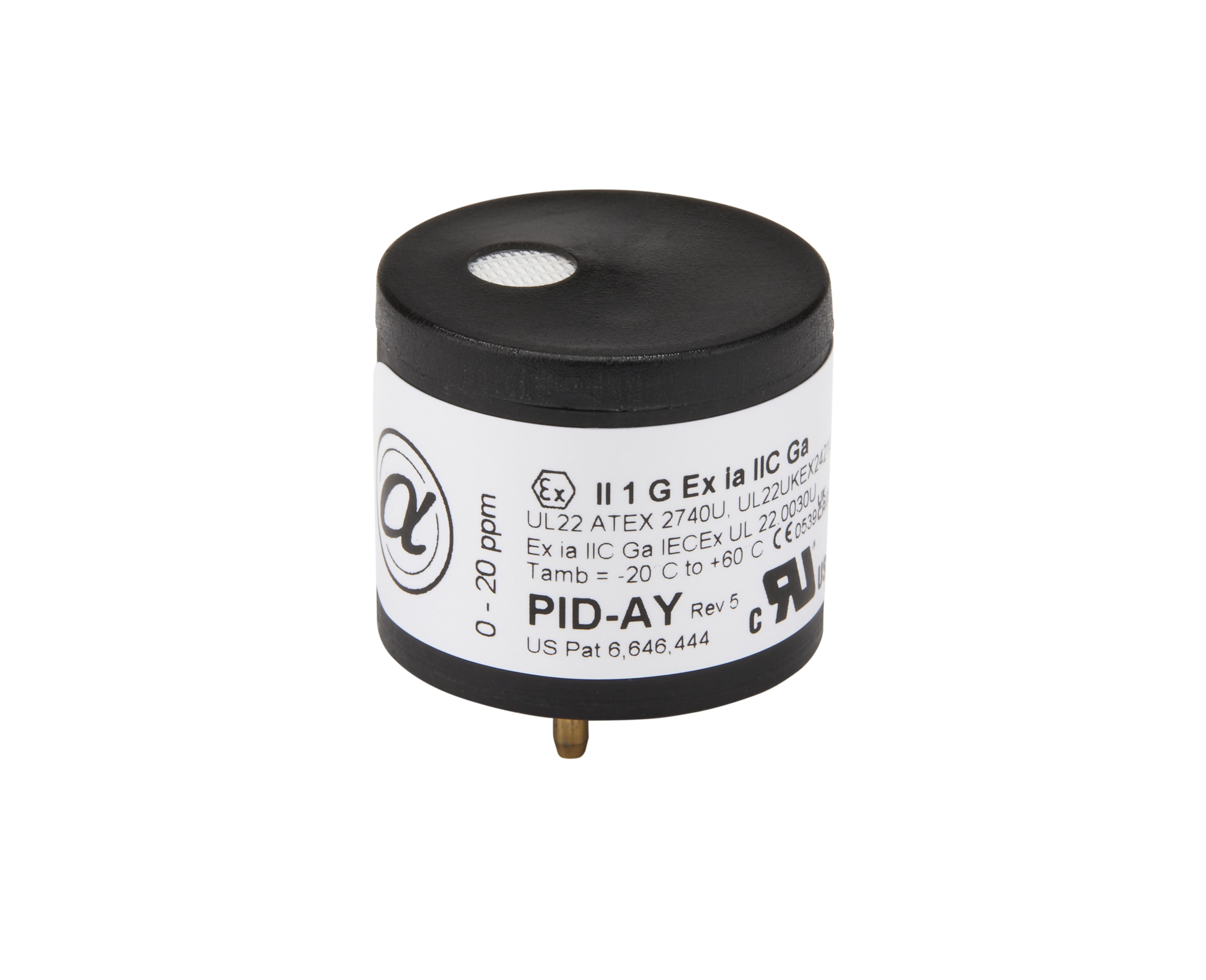
View our new advanced PIDX range of PID sensors and our legacy line of PID sensors developed for the detection and monitoring of Volatile Organic Compounds in even the harshest of conditions.
Photoionisation Detectors (PID)
With a PID, the sample gas is exposed to deep ultraviolet light.
The emitted light ionises targeted gases and they are then detected by the PID electronics and reported as a concentration (ppb or ppm).
PIDs can measure Volatile Organic Compounds (VOCs) to very low concentrations. Considered the gold standard for VOC measurement, Alphasense PIDs are compact and low power, with recently improved electronics and longer lamp life. An extended family of lamps now include better BTEX and chlorinated VOC detection. These sensors are pin-replaceable with the 4P90 pellistor.
Alphasense Advanced PIDX Sensors
The new advanced PIDX range of PID sensors is a direct, drop-in replacement for your existing PIDs, designed for demanding applications with unmatched sensor-to-sensor repeatability. The PIDX sensors feature a built-in lamp fault detection system, ensuring you are alerted when the device is not outputting correctly. With the PIDX range of sensors, you can measure VOC levels from zero to 10,000 ppm.
Read an exclusive Q&A on the new PIDX sensors: https://www.industrialhygienepub.com/email_blasts/editorial/ametek0524.html
Alphasense Legacy PID Sensors
The Alphasense legacy line of PID sensors include a detector with lamp driver, amplifier circuitry, and user replaceable electrode stack, 10.6 eV lamp and particulate filter.
Photoionisation Detector (PID) Guide
Download the Alphasense PID guide – see guide for full details.
Application notes
Download PID Application Notes – see application notes for full details.